

 Cryptocurrency

Crypto and Web3 projects still raise money the same broad ways traditional startups do (equity from venture capital and angels), plus a handful of methods unique to the industry: token sales, protocol grants, and, for asset-backed projects, security token offerings. Which combination makes sense depends on what stage you're at and how regulated your target investors expect you to be.
This guide walks through the main funding routes available to a crypto or Web3 project in 2026, what investors and grant committees actually look for, and the regulatory groundwork that now shapes any token-based raise touching the EU or US.
Understanding Web3 Fundraising

Web3 fundraising differs from traditional fundraising in one structural way: a project can raise capital by selling a token directly to its future users, rather than only selling equity to institutional investors. That opens the door to faster, more public raises, but it also means due diligence, disclosure and regulatory obligations that traditional seed rounds don't carry.
Traditional Funding vs. Crypto Funding
Traditional equity investment is slower to close (weeks or months of negotiation) but comes with clearer legal protections for both sides. Token-based crypto funding can close faster and reach a global pool of retail participants directly, at the cost of weaker investor protection and, in many jurisdictions, real securities-law exposure if the token is marketed as an investment.
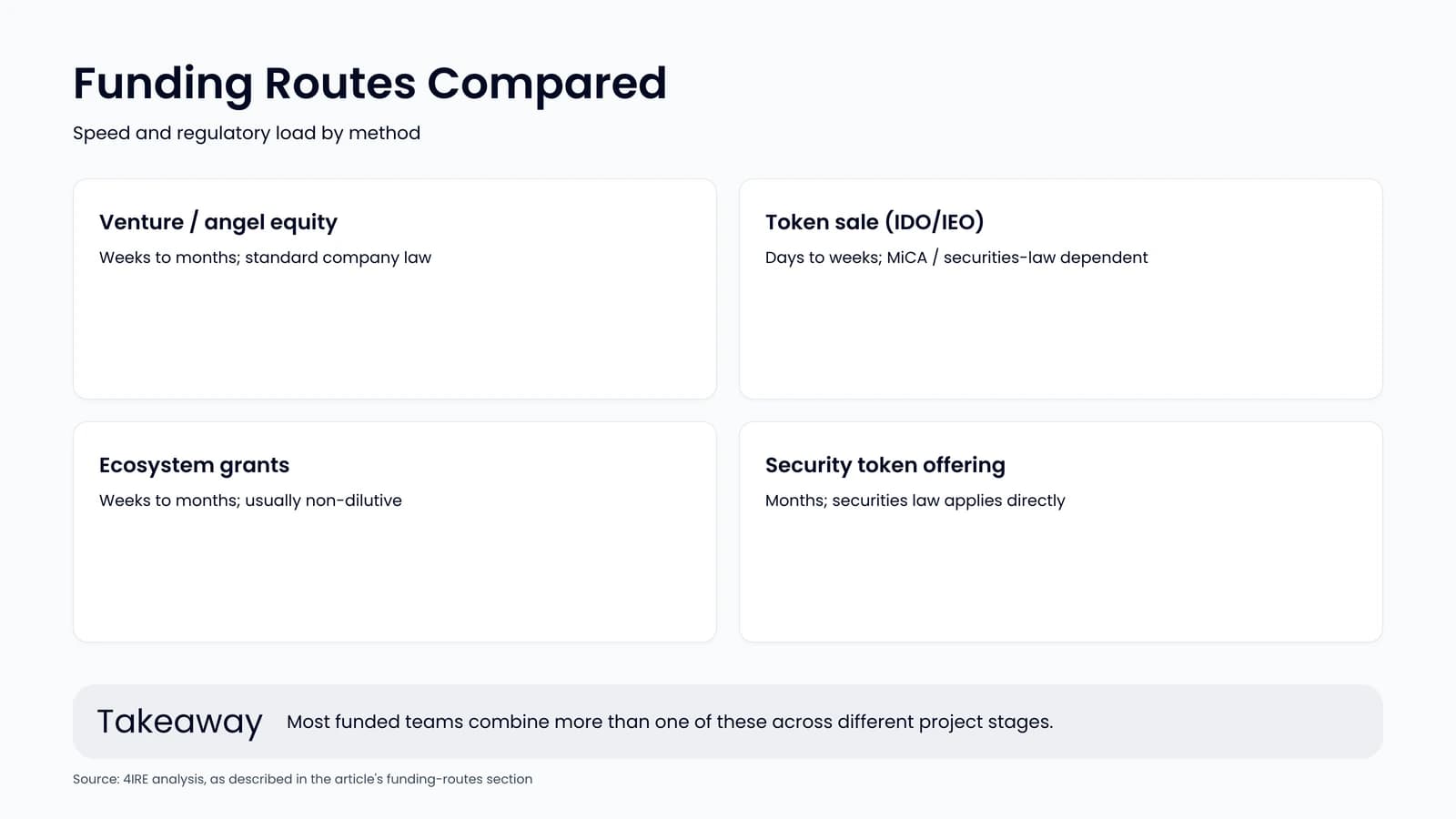
| Method | Typical Investor | Speed | Regulatory Load |
|---|---|---|---|
| Venture / angel equity | VC funds, angel investors | Weeks to months | Standard company law, cap table |
| Token sale (IDO/IEO) | Retail and crypto-native investors | Days to weeks | MiCA / securities-law dependent |
| Protocol grants | Foundations, protocols | Weeks to months | Low; usually non-dilutive |
| Security token offering (STO) | Accredited / institutional investors | Months | Securities law applies directly |
Funding Routes Available to a Crypto Project
Venture Capital and Angel Rounds
Blockchain-focused VC funds and angel investors remain the largest source of early-stage crypto funding, and the mechanics are close to a standard startup raise: pre-seed, seed, then Series A and beyond, with each round tied to specific milestones rather than a fixed schedule. A pre-seed or seed round from angels and small funds typically funds a working prototype and initial team; Series A and later rounds tend to require revenue traction or a live, audited product rather than a whitepaper alone.
Token Sales: IDO, IEO and ICO
Selling a native token (through an IDO on a decentralized exchange, an IEO on a centralized exchange, or, historically, an ICO run by the project itself) lets a project raise from its future user base directly. Our guide to initial DEX offerings covers the current mechanics and platform market in detail.
Protocol Grants
Most major blockchain foundations run non-dilutive grant programs to fund open-source tooling, infrastructure and applications on their chain. Grants are slower and smaller than a funding round, but they cost no equity or tokens, which makes them worth applying to alongside any other raise. See our roundup of blockchain grant programs for currently active options.
Security Token Offerings (STOs)
An STO tokenizes a claim on a real asset or a share in a company, and is treated as a securities offering by regulators rather than a utility token sale. It's a heavier compliance lift than a token sale, but it suits projects backed by real assets. See our guide to real-world asset tokenization if that's closer to your model than a native utility token.
What Investors and Grant Committees Look For
A Working Product, Not Just a Deck
Investors and grant reviewers both want to see a working prototype or live testnet, a clearly explained problem, and a realistic go-to-market plan. A well-designed tokenomics model (supply, allocation, and vesting that doesn't let the team dump on early buyers) is one of the first things a serious reviewer checks.
Team Credibility
Public, identifiable founders with relevant experience clear the bar faster than an anonymous team, especially for institutional and VC money. A track record of shipped products, even small ones, does more for credibility than a polished whitepaper.
Security and Audit Posture
Get an independent smart contract audit before pitching serious investors or applying to most grant programs. Many now require a completed audit or an audit commitment as a condition of funding, and an unaudited contract is a common reason both investors and grant committees pass on an otherwise solid project.
Regulatory Groundwork for 2026
Any token-based raise touching EU residents now sits inside MiCA: the regulation's public-offer and white paper rules for crypto-assets have applied in full since 30 December 2024, and the transitional authorisation period for crypto-asset service providers ended 1 July 2026. In the US, whether a token counts as a security is decided case by case under the Howey test, and that determination shapes which raise structure (token sale vs. STO vs. pure equity) is even available to you. This is general information, not legal or investment advice. Bring in counsel before setting the terms of any raise.
Funding Lifecycle of a Crypto Project

Most projects move through the same broad phases regardless of which funding routes they combine: preparation (concept, tokenomics, early marketing), a token sale or investment phase (pre-seed through public sale or listing), and post-launch development, where partnerships, additional listings and product releases build toward the next round. Planning your funding mix against these phases (grants and angel money early, a token sale or Series A once there's a working product) keeps you from raising the wrong type of capital at the wrong stage.
Common Reasons Funding Falls Through
The same handful of issues sink most raises regardless of method: tokenomics that let the team or early backers dump a large share of supply right after listing, no independent audit of the contracts handling investor funds, a founding team that isn't public or verifiable, and a fundraising structure that ignores the securities-law status of the token in the investor's home jurisdiction. Each of these is fixable before you approach investors or a grant committee. Fixing them after a raise has stalled is much harder.
How 4IRE Can Help
4IRE works with founders on the technical side of a raise: tokenomics design, smart contract development, pre-launch audits, and blockchain consulting on which funding route fits your project's regulatory footprint, whether that's a token sale, a grant application or venture financing.
Conclusion
There's no single right way to fund a crypto project in 2026. Most successful teams combine grants, angel or VC money, and a token sale at different stages, rather than betting everything on one route. What separates funded projects from the rest is the same in every route: a working product, sound tokenomics, an independent audit, and a clear-eyed read of the regulatory footprint your investors are in.
Planning a Funding Round or Token Sale?
Talk to our team about tokenomics, smart contract audits and which funding route fits your project's regulatory footprint.
FAQ
Venture capital and angel equity, token sales (IDO, IEO or ICO), non-dilutive protocol grants, and security token offerings for asset-backed projects. Most funded teams combine two or three of these across different project stages.
An ICO sells a utility token directly from the project's own site with little independent oversight; an STO tokenizes a security-like claim on an asset or company and is treated as a regulated securities offering. STOs suit asset-backed projects; ICOs are largely a legacy model today, superseded by IDOs and IEOs for utility token launches.
A token sale or grant lets you reach a global pool of users and contributors directly and, for grants, without giving up equity or tokens at all. It suits projects with a genuine token utility or an open-source component; it is not a shortcut around building a working product.
Match the method to your stage and asset type: grants and angel money for an early prototype, a token sale once you have a working product and audited contracts, venture rounds if you need larger capital with institutional support, and an STO if you're tokenizing a real asset rather than selling a utility token.
In the EU, MiCA's public-offer and white paper rules already apply, and the transitional period for service-provider authorisation ended 1 July 2026. In the US, whether your token is a security is assessed case by case under the Howey test. Get jurisdiction-specific legal advice before setting the terms of any raise.