

Why Are Carbon Credit Registries Entering Blockchain?
As the world is heading to an ecological catastrophe, global organizations and governments are getting increasingly concerned about ways to reduce carbon emissions and control the carbon footprints of plants, factories, industrial facilities, and business entities. Eco-friendliness and sustainability are at the forefront of everyone’s agenda today, and the answer to the problem of mounting CO2 emissions is carbon offsetting.
The principle behind carbon offsets is as follows: a company or individual plants a forest and calculates the volume of CO2 this plantation will sequestrate in the coming years. These are the credits they can sell to businesses producing CO2 emissions, “selling” the right to pollute the environment at the amount of CO2 their forests can absorb. This way, carbon offsetting is seen as an innovative way to compensate for CO2 pollution. The idea got immensely popular, with the present-day carbon credit market valued at $87.9 billion in 2022 and heading to $2.7 trillion by 2028.
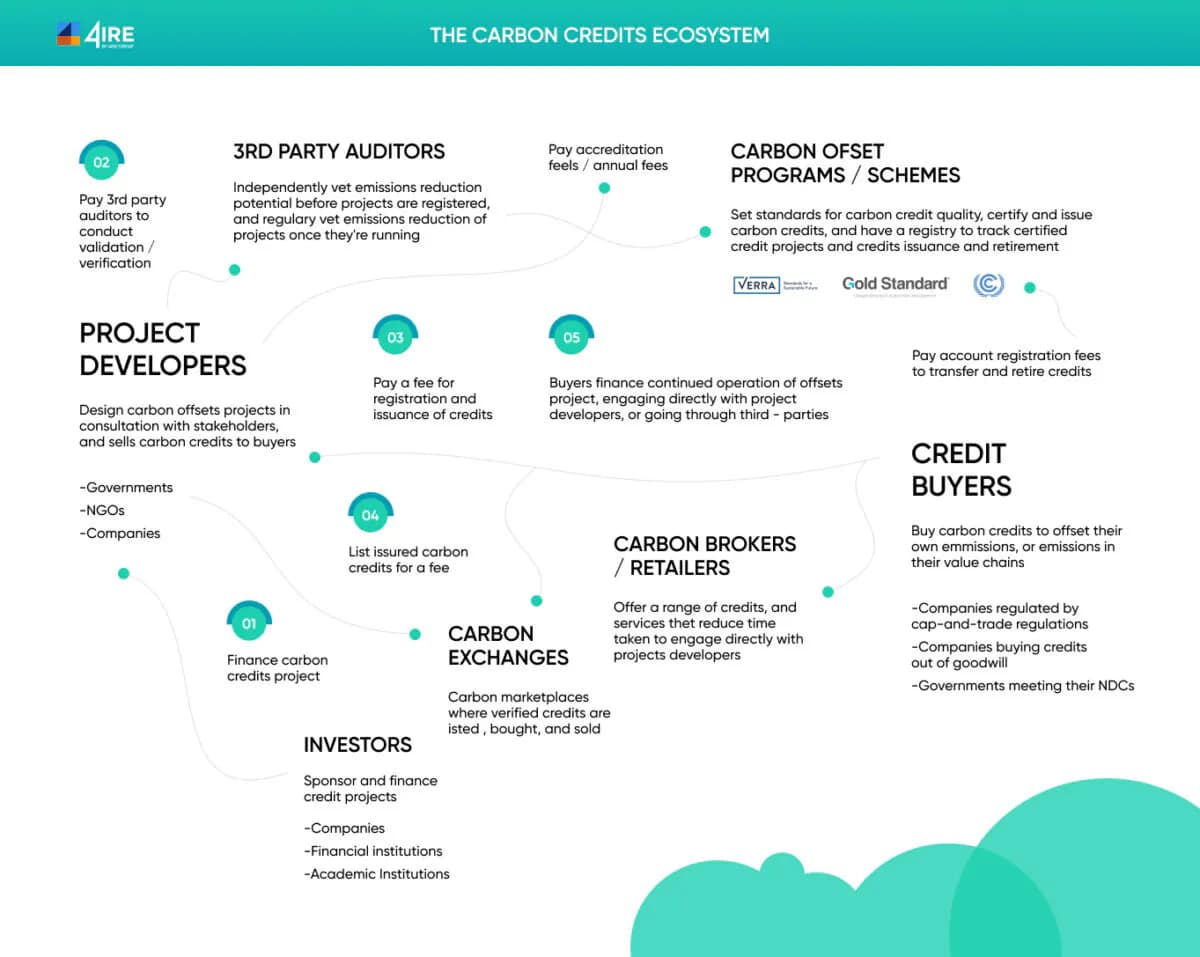
But the catch is that there’s virtually no centralized overseeing authority that would verify the value of every carbon credit sold in the carbon offsetting market. Does the seller indeed compensate for the sold number of metric tons of CO2, and how can this activity be measured? That’s where carbon credit registries enter the equation, offering a transparent and fair way of monitoring the carbon credit market. Here, I dwell on the role of carbon credit registries in the emerging GreenFi system and examine the potential gains from its gradual migration to blockchain.
What Are Carbon Credit Registries?
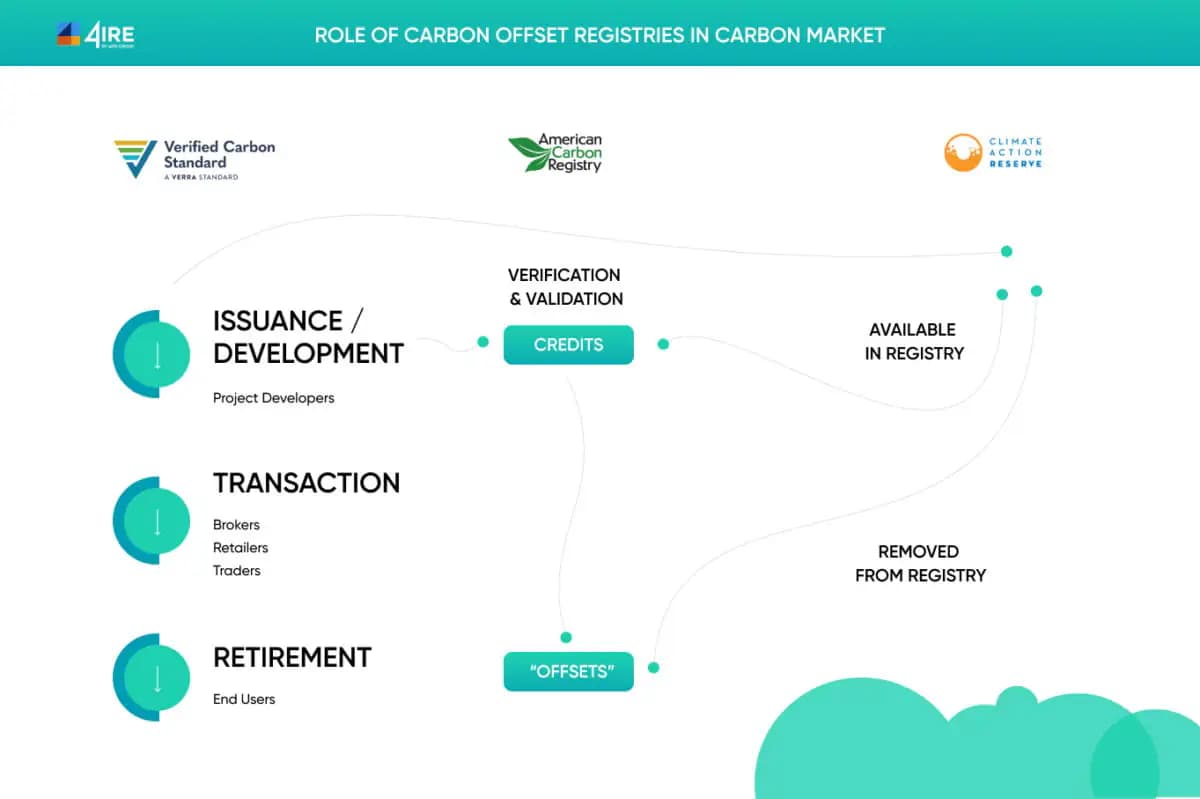
A carbon credit registry is a platform or database responsible for issuing carbon credits in line with specific certification requirements. The registry keeps a record of available offsets and guarantees the validity and transparency of all credits bought and sold in the market. This way, registries are trustworthy mechanisms for tracing the full carbon credit lifecycle, from its creation to retirement, which prevents the possibility of fraud or double counting.
The most widely used carbon credit registries are as follows:
- American Carbon Registry (ACR).
- APX Inc. – a company administering the Gold Standard Registry and Climate Action Reserve (ACR).
- Markit – an entity administering the Social Carbon Registry and Plan Vivo Registry.
- Verra is a platform administering the Verified Carbon Standard (VCS) registry and the Climate, Community, & Biodiversity Standards (CCBS) registry.
Here is an example of how a carbon credit registry works. Once the project developer issues carbon credits, it submits the latter for verification and validation by a reliable third-party registry. The registry’s auditors inspect the project’s background and double-check that the project indeed conducted the mitigation activities it claims to have completed, thus backing the CO2 credits it wants to sell. If the check is successful, credits get verified and get into the carbon credit trading system, where market participants can buy them. After the credit’s purchase and use, the carbon credit gets retired – that is, removed from the registry to avoid double sales.
What Is the Role of Carbon Credit Registries in the GreenFi System?
At present, carbon offset registries represent the backbone of the GreenFi market, as they are the ultimate authorities guaranteeing transparency, trust, and efficiency of carbon trading activities. The carbon market’s accountability is guaranteed with registries that perform the following functions:
- Enable effective carbon credit trading.
- Standardize CO2 measurements.
- Confirm emissions reductions achieved within mitigation activities of carbon credit issuers.
- Prevent double counting.
Due to these essential functions in the carbon market, registries act as vital guarantors of compliance among all market participants and commitment to realistic environmental improvements.
Top 12 Reasons for Carbon Credit Registry Adoption
If you’re a business specializing in carbon credit trading, partnering with a reputable registry is imperative for your success and credibility in the market. Here are the top reasons for the adoption of the carbon credit registry:
- Facilitating the issuance of carbon offsets.
- Efficient tracking of carbon credit units across multiple trading platforms.
- Transparent carbon credit retirement.
- Receiving the credibility and certainty of carbon credit origin and value.
- Review of offset programs’ validity.
- Improved environmental reputation for businesses.
- Achievement of sustainability goals.
- Exemplification of business commitment to battling climate change.
- Stimulation of wider adoption of carbon offsetting activities.
- Demonstration of adherence to emission reduction standards and protocols.
- Delivery of genuine environmental benefits.
- Transparent tracking and third-party evaluation of carbon credits.
Challenges & Current State of Blockchain Integration
It’s not a secret to anyone that the present-day carbon credit market experiences many challenges. It grows very quickly due to the pressing demand for CO2 offsets; yet, it is immature and non-transparent, which undermines its mission and causes many participants to question its legacy.
Here are the main complexities the carbon credit sphere is yet to overcome and potential solutions to these issues that blockchain promises.
#1 Transparency and Access to Data
Most carbon credits are traded in a non-regulated, decentralized market where the buyer can rarely access the full information about carbon credits’ origin and history. Without rigorous verification, carbon credits are often empty and unsubstantiated, becoming a monetization tool instead of a tangible environmental protection technique. Blockchain promises to solve this problem by giving universal access to each carbon credit’s origin and implementation of mitigation activities in the public ledger.
#2 Duplication
The problem with the current carbon credit market is double counting; as there is no system of unique labeling for carbon credits, some of them are resold many times. This way, no effective offsetting takes place, with the carbon credit seller getting unfair revenue with no sizable environmental improvement. With blockchain, all carbon credits are assigned unique codes and traced on the blockchain, which removes the ability to sell one unit several times on various carbon credit marketplaces.
#3 Environmental Efficiency
There is a lack of consistency in evaluating the efficiency of carbon offsetting projects. In other words, there is no comprehensive system for ensuring that an offsetting project indeed compensates for the specified number of metric tons of CO2. Blockchain may help solve this issue by creating an immutable, distributed tracking system for ineffective mitigation activity identification and removal from the carbon offset market.
#4 Costs of Running the System
Issuance of carbon credits and their trading are currently slow and costly. Market participants need to engage in lengthy red tape to complete the transfer of carbon credit ownership. This issue can be easily addressed with blockchain solutions, as on-chain transactions are quick, cheap, and efficient due to the use of smart contracts.
#5 Carbon Credit Quality
Since many carbon offsetting projects lack credibility and have vague origins, investors may grow distrustful of this market. Blockchain removes this problem by storing exhaustive information about every project and providing real-time, traceable data about its quality.
Unlock new opportunities in the carbon credit market
Build your own platform for trading and exchanging carbon credits to make a positive environmental impact while driving sustainability goals.
Real-World Examples of Carbon Projects Integrating Blockchain
Green Finance development is occurring at a fast pace today, with many carbon credit projects embracing the power of blockchain. Here are a couple of recent releases that have already attracted much attention and achieved success:
- Terrapass. This smart, blockchain-based app advises businesses and individuals on their carbon footprint reduction options. The solution helps users reduce carbon emissions by optimizing their commute to work and school.
- 3Degrees is a carbon-offsetting product that helps businesses optimize their production lines for greater efficiency and CO2-friendliness.
- KlimaDAO is a large-scale crypto carbon platform that buys and retires carbon offsets. This way, the DAO’s tokens – Base Carbon Tons (BCT) – represent one ton of CO2 removed from the atmosphere.
- Toucan Protocol is one of the most famous carbon credit projects, a pioneer in carbon offsetting that has already bridged 20+ million CO2 tons. It assists carbon credit-related projects with tokenization and offers a transparent and efficient blockchain infrastructure for the operations of climate-concerned projects.
What’s Next for Carbon Credits and Blockchain?
The present-day carbon credit market overview suggests that the sector is growing and enjoying ever-increasing demand and popularity. That’s why it makes sense to take a closer look at the future GreenFi trends one should consider and prepare for.
Broadening Focus
It’s evident that carbon offset registries are quickly evolving in line with the changing user needs. That’s why they are currently expanding their focus to cover various project types, from sustainable agriculture to local projects of social significance.
Transparency Improvements
Transparency and traceability are the key bottlenecks of the present-day GreenFi system, and blockchain is an innovative solution to this challenge. That’s why many carbon credit projects and registries are currently integrating innovative technologies like blockchain or ReFi carbon credit tokenization to enable easier access to data on carbon credits’ origin and value to increase trust and openness in this sphere.
Nature-Based Solutions
Carbon credit trading occurs in close tandem with nature-based solutions and environmental needs, so this sphere grows increasingly interested in nature-related projects. These include afforestation, restoration of endangered ecosystems, biodiversity enhancements, and carbon dioxide sequestration.
Projects of Social Value
Sustainability is impossible if attention is paid only to environmental goals; it should go hand in hand with social equity, which the present-day carbon credit registry market is also trying to embrace. Modern projects increasingly emphasize social and co-benefit initiatives within the carbon offsetting sector to ensure that local communities can also benefit from GreenFi activities.
FAQ
As the carbon credit market is still far from rigorously regulated, with many carbon offset projects escaping governmental oversight, the investors’ trust in them is often low. Blockchain can improve carbon credit projects and increase their credibility and transparency by keeping all processes, reporting, and tracking clean and accessible.
The main advantage of blockchain is the smart contract technology, which simplifies and automates carbon credit verification. These smart contracts are self-executing, so they can provide users with automated verification data in case the carbon credit project meets all validity criteria. Besides, blockchain is transparent and immutable, thus excluding the possibility of cheating or data manipulation.
Overall, blockchain integration in a carbon credit project is a costly endeavor, so it may be too expensive for small, local projects to handle this digital transition. However, larger projects and initiatives may incorporate blockchain technology without friction and move blockchain integration further, giving greater access to small businesses as well.
The greatest problem carbon credit projects on blockchain currently face is a lack of standardization. With a heterogeneous system of standards and a lack of unanimity on the principles of carbon credit validation, these projects often face low investor trust and even pose a risk of double scoring. Besides, carbon credit market participants still face the need to learn the technical complexities of transacting on the blockchain, which has a considerable learning curve.
Connect with us to set up a meeting with our expert
We’ll explore project milestones, budget specifics, and technical requirements for GreenFi project development. Let’s collaborate to make your GreenFi initiatives more accessible and impactful.